
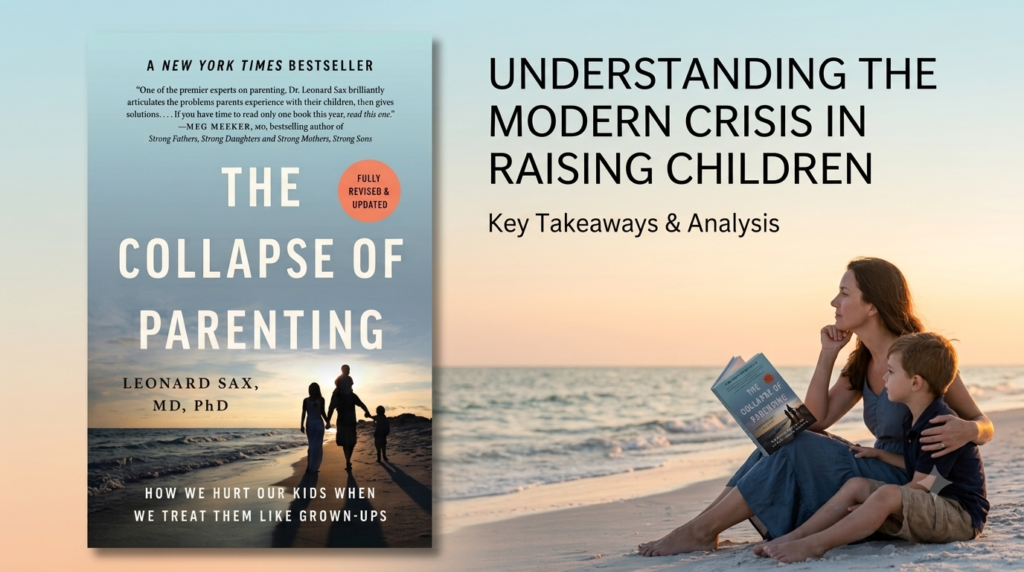
THE COLLAPSE OF PARENTING book by Dr. Leonard Sax, MD, PhD, Basic Books, NY
We believe Dr. Sax addresses in a heartfelt and scientific way, some very timely issues that many parents have not yet found answers for. His care and concern for children and families is evident and his understanding that cultivating virtue and wisdom into our children and youth will eventually lead to a better society is highly encouraging.
Another Recommendation:
As a school principal, I have observed firsthand the ‘culture of disrespect’ which Dr. Sax describes so accurately in his book. While designed primarily as a guide for parents, he provides concrete examples that school leaders and teachers can use to encourage character building in children. Clear, insightful research and practical solutions make it an excellent resource for any school or classroom.
Sarah Blair, Principal, Pine Creek Colony School, Austin, Manitoba
SAMPLE BEHAVIORAL ISSUES CITED BY DR. SAX
-
- Dr. Sax relates a situation he had when a 6 year old girl suffering with a fever and sore throat was brought to his office by her mother and refused to open her mouth so he could examine her. He then asked her mother to please have her daughter open her mouth. The mother’s response was, “Her body, her choice.”
What’s a doctor to do?
-
- He then speaks of Kimberly an 8 year old girl who was allowed to choose the private school she would attend even though her parents felt the teachers looked bored at that school and the administration refused to tell them where their graduates went to high school. They much preferred another school where the teachers were enthusiastically engaged with the students and the student outcomes were well documented. However, they allowed their daughter to make the choice to go to the other school because the daughter liked one of the students she had met there. Her mother said, “I think good parenting means letting kids decide. That’s how kids learn, right?”
We agree that children should be able to make choices appropriate for their age such as what instrument to play in the school band, what color coat to buy, who to invite to their party. But life forming decisions such as health, education, and safety should be guided by parents who will make the ultimate decisions whether consulting with their child or not, and if appropriate, parents may explain why they made that decision.
-
- A third example Dr. Sax shared concerns Mr. and Mrs. Philips, parents who were concerned about high school kids who appeared to be drunk but were still driving a car. They wondered what to do about this situation as they had sons in high school who enjoyed having parties at their home. Although they didn’t serve alcohol, friends of their sons sometimes arrived already having had alcohol elsewhere. So Mr. Philips decided to buy a Breathalyzer and at the next party he handed the Breathalyzer to a boy and asked him to breath into it. And you guessed it, he was drunk. Mrs. Philips then called the boy’s parents asking them to take their son home. These parents, however, were offended by the phone call. Although they did pick up their son they did not express any appreciation or thanks to the Philips.
The use of the Breathalyzer displeased other parents also. “Kids these days are going to drink, whether you like it or not,” said one mother. “Even at the age of 15?” “At whatever age,” was the reply.
It is unwise as well as illegal to give alcohol to kids. If you had to pick up your child in this situation, what would you say to him? You might try something like this: “I can see you are not in a good place right now. Your health and safety are my priority. Let’s get you home and we’ll talk about it when you are feeling better.” This approach focuses on ensuring their safety and defusing potential conflict while emphasizing the need for a proper conversation at the right time.
This same parent was seen a few days later picking up her younger son at school. He jumped into the back seat and when his mom asked him how school was that day, his reply was, “Turn around. Shut up. Drive.”
How would you respond to this command? A thoughtful response might be: “I understand you might be feeling overwhelmed right now, but it’s important to communicate respectfully. I will be ready to listen to how your day went this evening before dinner if you would rather wait until then.” This approach addresses the command while setting a positive tone for the conversation.
-
- Dr. Sax relates yet another story about a mother’s concern that her 8 year old son suddenly became terribly disrespectful to both of his parents. Having no idea where this was coming from, they consulted Dr. Sax who in turn asked if their son watched the Disney channel, Nickelodeon or Nick Jr. When they responded that he did, Dr. Sax strongly advised that he no longer be allowed to watch these programs. After a few weeks the mother called to say how amazed she was that all of the disrespectful behavior had disappeared and their son was back to his sweet self again.
Would you follow Dr. Sax’s advice if you were in a similar situation? Would you prefer to give your child complete autonomy over what he will watch and put up with his disrespectful behavior or would you choose to use your wisdom and experience as an adult to set appropriate limits for his entertainment?
WHAT IS CHILDHOOD FOR?
You might think it’s for biological maturation, suggests Dr. Sax, but Culture is the answer. He explains that it takes many years for parents and other grown-ups to teach the culture to their child. He tells us there is no shortcut. Now we might wonder what it means to learn a culture. He explains that it is how people get along together within that culture, what rules of behavior they have that might be different from other societies. And of course, no child is born knowing these rules so we must teach them!
Role Confusion
Since children are no longer taught socialization skills in school, this job now falls singularly upon the parents. And because we currently live in a culture where kids no longer value the opinion of their parents but defer to the opinion of their peers, this makes it even more challenging for parents. Dr. Sax explains that parents are suffering from role confusion and aren’t certain how to exercise their authority. He tells them they must learn how to do this, and it doesn’t mean they must be strict disciplinarians. Then what, you may ask. “Just Right Parenting” may be the answer.
WHAT IS JUST RIGHT PARENTING?
While just right parents consistently enforce the rules, they also show abundant love to their children and let them make age appropriate decisions for themselves. Dr. Sax explains that research has shown that the healthiest parenting style is the Just Right style, not too hard, not too soft, but just right. He believes it is an important part of parenting to help each child develop character, self-control and conscientiousness. In fact, he says, it is mandatory for all parents, not just superior parents. There is no greater responsibility!
For more ideas and understanding of the importance of Character Development and how to promote it, please see articles posted on this website for more information and consider purchasing the books below.
If you appreciated the wisdom of Dr. Sax, you may also enjoy another popular book on this parenting topic by Gordon Neufeld, PhD. who is mentioned several times in Dr. Sax’s book.