
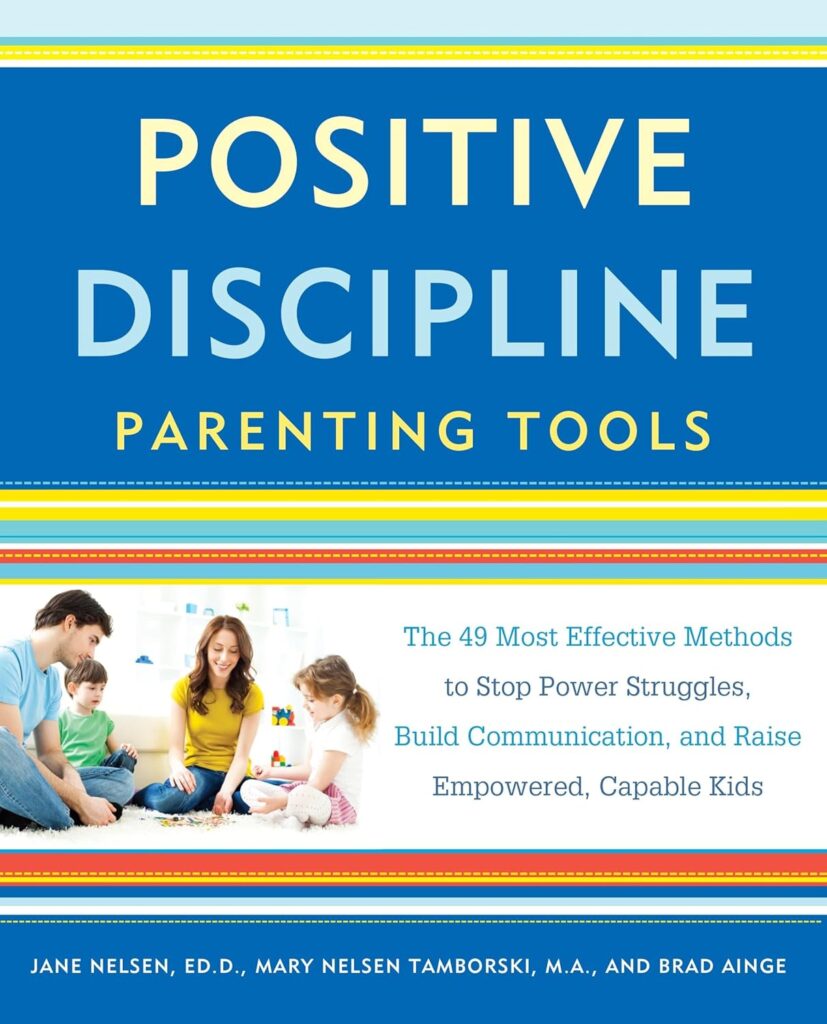
It’s easier than you think to get your children to cooperate with you.
 If you find yourself feeling out of sorts, not knowing what to do about your child’s behavior, breathe deeply and give yourself a few minutes to review some of these simple, easy, and practical tools – in the Positive Discipline book—its’ link is below – to help you and your loved ones hit the refresh button and take care of yourselves for the long haul.
For instance, learn about encouragement, the importance of validating feelings, understanding the brain, problem solving without dwelling on the negative, family meetings, setting boundaries, and even how to foster creative thinking. This is an easy read with success stories related to various real life problems – like who washes the dishes, when do I have to do my homework, learning to make choices (which toothbrush to use – or getting to school on time (ride bike, in car on time, or walk).
How Do We Change Our Ingrained Parenting Habits?

Many times, we parent the way we were brought-up. Our parenting behaviors can be highly ingrained and become habits we perform automatically without thinking, but after trial and error we find out that these negative behaviors are not always the best techniques. You know what I mean – chastisement, control, yelling, spanking, punishment (blame, shame, pain), and rewards.
In any walk of life, to achieve success children need discipline. But can we parent and discipline without punishment? Yes!
You will find that the positive discipline method incorporates the idea of encouragement, empowerment, and mutual respect. This book, Positive Discipline Parenting Tools, is a book of techniques and an encouragement model that uses the golden rule to help the parents and families learn how to find solutions to everyday problems in a kind and firm way.
In this guidebook, we learn that discipline is all about guiding children, being neither permissive nor punitive – and we are given real world techniques that help us teach our children to learn self-discipline without losing ones’ dignity.
Go online and see blogs and videos that will also help you peacefully guide and work with your children.
The link is Blog | Positive Discipline
Ideas such as Family Meetings can ease disputes about homework, chores, bedtime, etc.
Family Meetings

After the Family Discussion – Let the children come up with their own solutions.

Example: When and how to do homework
Maybe the child is unhappy being alone and decides he needs time with dad first or wants to do his homework in the same room as dad

So, by discussing it in a Family Meeting, you can
Go from here to here  by using the child’s solution

This child wanted to be with his parent, now he’s happily doing his homework and working just like dad!
OR

Maybe these children choose to do homework with one parent while the other parent cooks. If it brings peace to the family, it is a victory!
The following paragraph is an example of ideas that you can discover by going to The link Blog | Positive Discipline
Encouragement is not Cheering, Clapping, and Commenting on Everything a Child Does
Too often parents and teachers talk too much. Sometimes the talking is called “lecturing,” and sometimes it is an attempt to be encouraging. A trend today is for adults to think they have to make a comment (in the name of encouragement) on everything a child does.
Even worse is when they think they should clap and cheer. Imagine you are a two-year-old child and you have just poured your own milk from a small measuring cup into a small cup. What are you feeling? When I get into that role, I’m feeling proud of myself—and very capable. Stay in the role and now imagine your mother starts clapping and cheering? What are you feeling now? When I get into that role it is interesting that I still feel proud. I even like it that my mother is cheering. However, when I dig deep, I’m starting to believe I need to do well to please my mother.
Clapping and cheering for every small deed is a form of praise, and the danger is that children do like it. They don’t understand the subtle beginnings of the need to please and/or the fear that they might not. All of these feelings and decisions are being formed at a subconscious level. Cheering, clapping and commenting on everything a child does are subtle ways of making your child’s accomplishments more about you than about him or her. It actually robs your child of maintaining his or her sense of personal satisfaction and feelings of capability.